
The Completeness of Scripture

The three previous articles in this series addressed the necessity, content, and character of Scripture as set forth in chapter 1, paragraphs 1-5, of the Westminster Confession of Faith. Paragraph 6 turns to the subject of the doctrine often called the sufficiency of Scripture, which raises the question in what sense is Scripture sufficient? For an answer it is essential to back up to paragraph 1 of the chapter where it is seen that “the light of nature, and the works of creation and providence … are not sufficient to give that knowledge of God.” This insufficiency must be supplemented with something efficient for the task. That something is the infallible written revelation of God called Scripture. Orthodox Christianity knows that the foundation of God’s communication of his will to man is his condescension to reveal it authoritatively and finally in Scripture.
The whole counsel of God, concerning all things necessary for his own glory, man’s salvation, faith, and life, is either expressly set down in Scripture, or by good and necessary consequence may be deduced from Scripture: unto which nothing at any time is to be added, whether by new revelations of the Spirit, or traditions of men.
The term “whole counsel of God” comes from Acts 20:27 which is within Paul’s address to the Ephesian elders gathered at Miletus just before he set sail for Jerusalem never to return. He said to the elders, “I did not shrink from declaring to you the whole counsel of God.” At the time Paul said these words that were then recorded in Acts by Luke, there were only a dozen or so books written that would become the New Testament canon. Books continued to be written by their inspired authors until well into the first century. however recognition of their canonicity was not achieved until, as the article, “The Content of Scripture,” in this series pointed out, 367 A.D. Christians today sometimes look back to Bible times thinking how wonderful it would have been to live then and hear the prophets, walk with Jesus, and read Paul’s epistles as they circulated among the churches, but it should be understood that the whole counsel of God was not complete until more than three centuries after the New Testament books were written. The generations that lived after the canon was completed had and have the whole counsel of God while the first centuries of the church lived with a lesser canon—it could be said, the completed canon of the Bible is better than being there because the whole counsel of God is his complete revealed will.
While the New Testament books were being written the Old Testament was the Scripture of the church. Philip’s encounter with the Ethiopian eunuch struggling to understand Isaiah’s prophecies exhibits the importance of the Old Testament for first century Christians. The eunuch’s question in Acts 8:34, “About whom, I ask you, does the prophet say this, about himself or about someone else,” which resulted in Philip expositing the passage by preaching Christ to him and baptizing him. The use of the Old Testament in antiquity should remind Christians today that the gospel was first provided in Genesis through Malachi and the whole counsel of God available then included considerable texts from the Old Testament.
The whole counsel of God is concerned with “all things necessary for his [God’s] own glory, man’s salvation, faith, and life.” Scripture includes everything required to know how, as the Shorter Catechism puts it, “to glorify God, and to enjoy him forever” (Q1). Thus, Scripture is sufficient while the light of nature, creation, and providence are insufficient.
B. B. Warfield is well known for his copious collection of writings concerning the doctrine of Scripture. In these writings he occasionally uses the term “sufficiency of Scripture,” but he prefers to use completeness, or occasionally perfection. In his, “The Doctrine of Holy Scripture,” he says,
The second property of Holy Scripture which the Confession adduces is its perfection or completeness (paragraph 6). Here the absolute objective completeness of Scripture for the great and primary purpose for which it is given is affirmed; and the necessity of any supplement to it is denied, with reference especially to the “new revelations” of the sectaries and the “traditions of Rome” (Works, 6:224).
Warfield’s, “the necessity of any supplement to it is denied,” is more comprehensive than the concept of sufficiency—nothing can be added to Scripture, it could be said it is complete. For example, if the tires of an automobile are engineered to take a maximum pressure of forty pounds per square inch and the minimum for safe driving is thirty, then any pressure from thirty pounds to just short of forty would be considered sufficient, but once the pressure gauge indicates forty, the inflation has achieved its perfection or completeness. Warfield’s preference for the term completeness of Scripture shows his concern to deny the possibility of its ever being supplemented.
All things needed to glorify and enjoy God are “either expressly set down in Scripture, or by good and necessary consequence may be deduced from Scripture.” Which things are expressly set down in Scripture? Some examples are the Ten Commandments which are listed in both Ex 20:1–17 and Dt 5:6–21, then in the New Testament the Lord’s Prayer is given as both a prayer to be prayed and a model for praying in Mt 6:9-13. Instructions and qualifications to be considered for selecting elders and deacons are laid out in 1 Tm 3:1-13 and Tt 1:5-9. What is to be believed and used to order one’s life and the work of the church is clearly given in Scripture, but some things must be deduced by good and necessary consequence. For example, returning to Philip and the Ethiopian eunuch, good and necessary consequence comes into play, “And he commanded the chariot to stop, and they both went down into the water, Philip and the eunuch, and he baptized him. And when they came up out of the water, the Spirit of the Lord carried Philip away, and the eunuch saw him no more, and went on his way rejoicing.” (Acts 8:38-39)
It is clearly stated that both men entered the water, that the eunuch was baptized, and then that both came out of the water onto land, however the great question for baptism debates is, how was the water of baptism administered, by immersion or sprinkling/pouring? Much of the debate is concerned with the meaning of “into the water” and “out of the water.” For Presbyterians Philip and the eunuch stepped into the water and stood while Philip scooped some of the water and administered it to the eunuch’s head; for Baptists, the eunuch was immersed as Philip lowered him into the water. The good and necessary consequence is viewed through Presbyterian covenantal eyes as sprinkling/pouring, but according to Baptists the water was applied through immersion. Both sides of the debate believe they have correctly used good and necessary consequence for their views, but they come up with different conclusions.
Since Scripture is, using Warfield’s term, complete, “nothing at any time is to be added, whether by new revelations of the Spirit, or traditions of men.” The completed canon allows no appendices. There are two categories of supposed additions that are mentioned. The first category is “new revelations of the Spirit.” It is the Assembly’s intention that these supposed revelations are necessarily false because Scripture is complete. Church history has seen numerous individuals claiming to have revelations from God. At the end of the second century a Phrygian (eastern Turkey) named Montanus announced that he was totally controlled by the Holy Spirit and he would inaugurate a new age of divine revelation. Among his followers were Prisca and Maximilla who claimed to be prophetesses bringing new teaching to the movement. Montanists claimed new revelations of the Spirit. During Martin Luther’s era in the early sixteenth century there was a group of Anabaptists that followed Thomas Müntzer and they held to his teaching about continuous personal inspiration by the Spirit. They even said their revelations were superior to Scripture. These men were Nicholaus Storch, Thomas Dreschel, and Markus Stübner, whom together Luther called the Zwickau prophets. Then not yet quite on the scene at the time of the Westminster Assembly is the founder of the Quakers, George Fox, who believed Christ is in everyone and all individuals have the Inner Light to direct them. For Fox, the Inner Light directs and truth of the Bible is confirmed when its spiritual meaning is authenticated by one’s experience. God essentially reveals continuously according to Fox’s teaching.
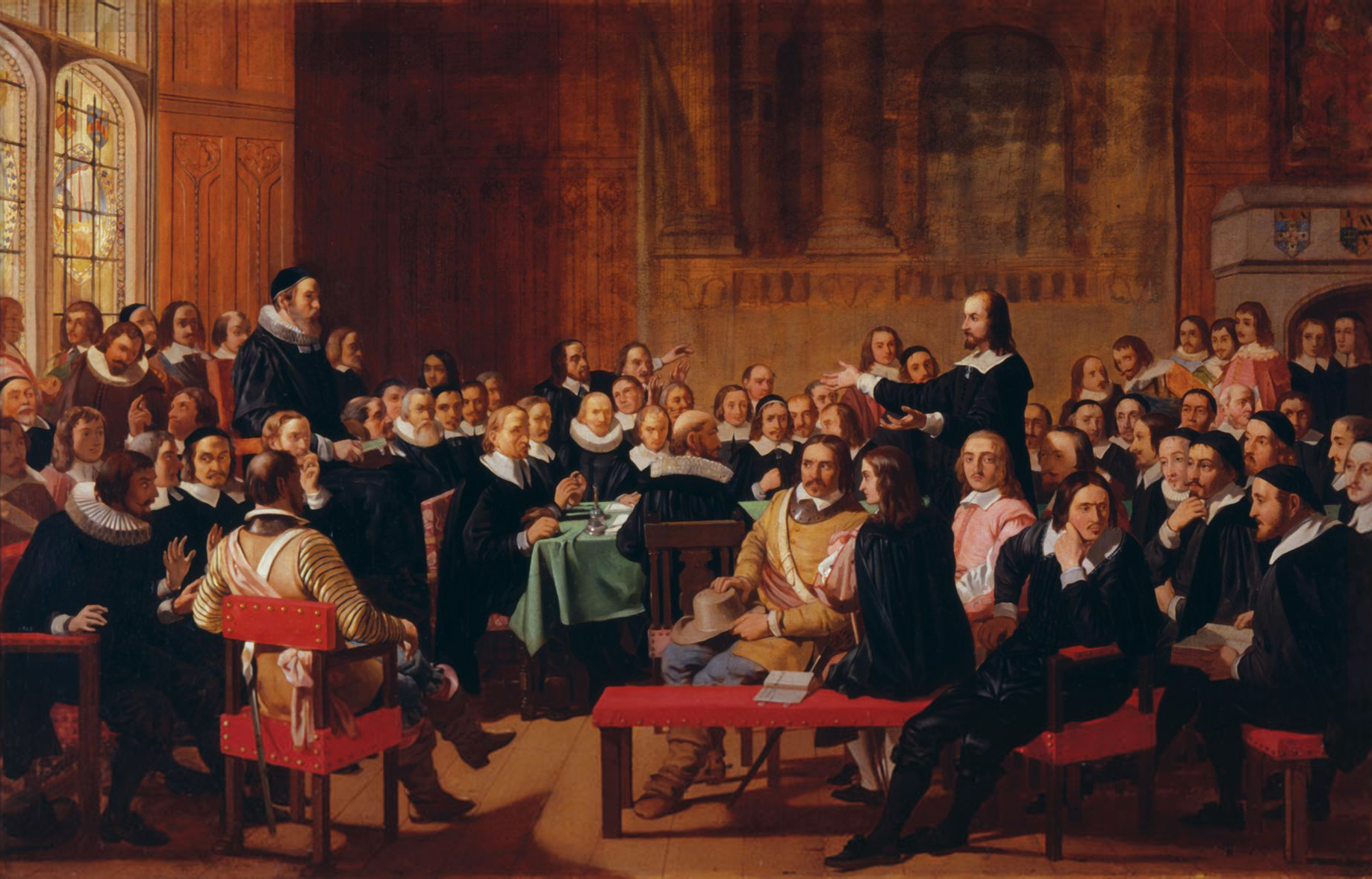
The second category against adding to Scripture is the “traditions of men.” This category has its immediate and largest representative in Roman Catholicism. For Catholics tradition combines Scripture, historic ecumenical creeds, practices of the Church since the apostolic age, the writings of church fathers, as well as other sources which combine to make Tradition. The capitalization of the word tradition indicates its importance for Catholics. The Westminster Assembly recognized that the documents it composed might be considered tradition, but it did not claim the documents to be infallible but instead a highly reliable document for faith and life. The Westminster Confession in 31:4 even states the possibility that synods and councils, which would include the Westminster Assembly, could err.
All synods or councils since the apostles’ times, whether general or particular, may err, and many have erred; therefore, they are not to be made the rule of faith or practice, but to be used as a help in both.
If the Westminster Assembly erred in the content of its documents, then as errors are recognized it could be concluded from 34:1 that those errors could be corrected. The Assembly also made it clear that the supreme judge for all issues of faith and life is Scripture, and the Assembly’s documents are “a help in both.”
Nevertheless, we acknowledge the inward illumination of the Spirit of God to be necessary for the saving understanding of such things as are revealed in the Word;
A number of years ago I was skimming a magazine and came across “Look Who Reads the Bible!” at the top of an advertisement promoting Bible reading. It is a good thing to read Scripture, but in the case of the celebrities pictured whose troubled lives were ever before the public, it appeared they lacked “the inward illumination of the Spirit of God.” The Bible in one sense is just like any other book—nouns are still nouns, verbs are verbs, and proper syntax is required for clear communication, but it differs in that it is God’s infallible tool to bring the elect to himself and grow them in grace. The Bible is admired by many because of its presentation of history, the personalities used by God that provide wonderful narratives, the beauty of its language, and all the other glories of Scripture, but without the work of God as the Spirit illumines the reader’s understanding, one cannot have a saving understanding. The Spirit cannot be stirred up as though the second person of the Trinity is available at man’s beck and call, but instead the Spirit works illumining the understanding of its readers so they can embrace the Gospel and continue to grow in grace.
The Scripture provides the Christian with all that is needed to glorify and enjoy God, but there is other knowledge needed to fill in some of the practical gaps. The Assembly expressed it this way,
and that there are some circumstances concerning the worship of God, and the government of the Church, common to human actions and societies, which are to be ordered by the light of nature and Christian prudence, according to the general rules of the Word, which are always to be observed.
A circumstance concerning the worship of God that is ordered by the light of nature is how the church is to receive tithes and special offerings to support the ministry of the church. In Bible times a tithe might have been tangible goods such as a portion of the giver’s crops or items from the church member’s trade, but now what is most often given is money. How are these funds collected today? In the West among many Protestants the offering is collected with some type of container or dish which is usually an offering plate. The plate might be made of wood, metal, glass, plastic, porcelain, or if worshipping at summer camp with a group of young people the container might be a soft drink cup. Other devices include a bag for the money at the end of a stick that is carried by an usher from parishioner to parishioner. Some churches pass special boxes with holes in the top to insert funds in order to hide the amount of the gift from others. Other traditions have offering boxes at the door so people can insert tithes when entering or leaving. Currently, some churches have gone to donation by electrons on the Internet, unfortunately some use it exclusively, but others still pass the plate while using digidollars to receive gifts from shut-ins, travelers, and others. The variety of collection devices and the point in the liturgy when the offering is collected are determined primarily “by the light of nature and Christian prudence, according to the general rules of the Word, which are always to be observed.”
To this point in the Westminster Confession, chapter 1, it has been seen that the Assembly had the highest regard for Scripture. Though the light of nature including God’s handiwork in creation and the sense of deity in the mind are wonderful manifestations of the existence of God, they cannot bring anyone to believe the gospel and embrace Jesus Christ—only Scripture can provide salvific knowledge. Since the Bible is required for providing revelation of the gospel, it is important that there be confidence in all that it says, so God has provided the canon of Scripture that brings certainty that those things said to be said by God are in fact his words provided by holy men moved by the Holy Spirit. Finally, paragraph 6 assures us that Scripture tells us all that we need to know regarding the gospel, worship, and growing in grace. The Bible is not to have anything added to it, nor is it to have anything removed.
Notes—Dating the New Testament books varies among sources, the books completed by 58 A.D. could differ a bit, and some scholars believe the New Testament canon was completed by A.D.70. The edition of Warfield’s works used is The Works of Benjamin B. Warfield, in 10 vol. published by Baker in 2000, which is a reprint of the Oxford edition of 1932. For reference the commentary on the confession by A. A. Hodge was used, A Commentary on the Confession of Faith: With Questions for Theological Students and Bible Classes, Philadelphia: Presbyterian Board of Publication, 1869.