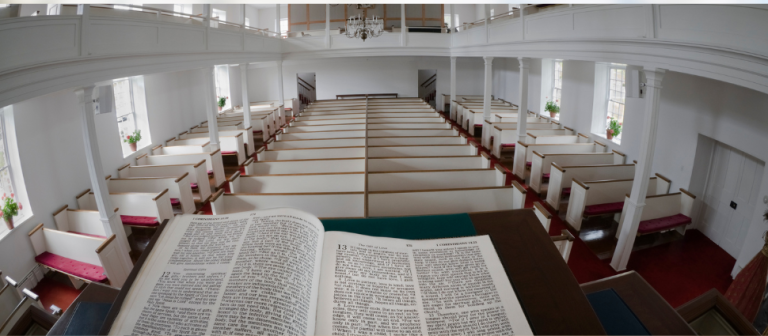

Progressing in the Pulpit

Every pastor probably recalls with a shudder his first attempt at a sermon.
My first sermon was in seminary back in 2001 when the homiletics professor assigned me Romans 2:12-16. It’s about how those “who sin apart from the law will perish apart from the law,” and how those who “sin under the law will be judged by the law.” The apostle goes on to say that even though the Gentiles do not have God’s law, they sometimes by nature do things required by it.
This is a taxing text. I struggled to understand this piece from Romans, let alone explain it coherently or apply it winsomely, to say nothing of preaching Christ from a text that barely mentions him. I am sure that I did poorly on all counts. What I experienced that day was an early introduction to the truth that for a minister, preaching is a task simultaneously enriching and perplexing, both a great joy and a mighty struggle.
Since my first (bad) experience of preaching, God has let me continue to bring his Word to his church. By now it’s been at least 1500 sermons over the last twenty years of ministry.
Along the way, one passage that I’ve often reflected on is 1 Timothy 4:6-16. It’s in a letter of instruction and encouragement for those called to minister among God’s people. After exhorting Timothy to devote himself to the public reading of Scripture and not to neglect his gift, Paul encourages him, “Be diligent in these matters and absorbed in them, so that your progress will be evident to all” (v. 15).
Those words about progress really resonate. During my ministry, I sometimes despaired at my utter inadequacy to feed Christ’s sheep. At other moments, I proudly thought that I didn’t need to progress much anymore, that I had already attained an imagined pinnacle of excellence. But in both respects, God used this text to put me straight.
Paul tells Timothy to be diligent in preaching so that people will see his progress. Timothy was a young man who struggled with a sense of inferiority, and he had a lot to learn. So his spiritual father gently exhorts him. To do his work faithfully and fruitfully, he will need to continue to grow in both character and competence. Don’t rest on the praise you received last Sunday. Don’t cave in to your critics or to your doubts. But be absorbed in this holy work so that you can pursue excellence to the glory of Christ.
It’s a fitting text for every preacher to reflect on often. We want to progress in our ability to exposit, apply, and deliver God’s Word, and we would like our progress to be evident to those whom we serve. To be sure, every preacher is gifted in different ways, and we bring our particular weaknesses into the pulpit, too. But through diligent attention to this holy work, every preacher should aim to grow. Allow me to make a few suggestions:
- We should periodically devote time to reflecting on our craft, evaluating our own preaching to see whether we are truly growing. In this activity, we should not be guided by our changing moods, nor should our assessment be tied solely to the variable responses of the congregation. But we should “evaluate our preaching as a servant anticipating our Master’s evaluation.”[i] This is reflecting in the sight of God and by the measure of his Word whether we are progressing.
- We should listen to excellent preachers. This is what Augustine once said, “Men of quick intellect and glowing temperament find it easier to become eloquent by reading and listening to eloquent speakers than by following rules for eloquence.”[ii] In our time, we are blessed with access to a wealth of solid expositional preaching. We can learn from the masters and so many more. What makes their sermons effective? What makes their delivery compelling? How do they go about preaching Christ?
- The elders are charged to direct the affairs of the church and to maintain sound doctrine. Supervising the preaching is an important aspect of this task. Sermon review is essential, yet sermon feedback is hard to do well. A well-developed sermon rubric can facilitate elder dialogue about the preaching. Another approach is to solicit sermon feedback from a representative group in the congregation. How are young people hearing the preaching? Or how are the applications landing in the families? As preachers, we understand that receiving feedback can be painful yet it is so valuable for growth.
- It can be helpful to find a community of fellow preachers.[iii] Take one of your sermons and share it for another preacher to read. As men who are handling the Word all the time, our fellow preachers have good insights. They will surely help us to grow.
- Preachers should keep reading about homiletics. A good book on preaching can refresh you in the fundamentals of the craft and help you make adjustments to your style as patterns of communication change. A good book on preaching will also impress you with the so-called theology of preaching, how Scripture presents this marvelous human activity which God uses to generate saving faith. I know some pastors who read a book on preaching every year to facilitate deeper thinking about this crucial part of our work.
Progress looks different for different preachers. Yet God’s Word compels all of us to aim for growth according to the measure of our ability, to pray to the Lord for that growth, and to help one another to grow.
This is how Charles Spurgeon put it to his ministerial students, “I give you the motto, ‘Go forward.’ Go forward in personal attainments, forward in gifts and in grace, forward in fitness for the work, and forward in conformity to the image of Jesus.”[iv]
May this be every preacher’s holy ambition, that by “being diligent in these matters and absorbed in them, our progress will be evident to all.”
[i] Joel R. Beeke, How to Evaluate Your Sermons,” Puritan Reformed Journal 3 (2011): 255-78, 257.
[ii] Augustine, On Christian Doctrine, IV.3.4.
[iii] Jonathan T. Pennington, Small Preaching (Bellingham, WA: Lexham Press, 2021), 18.
[iv] C.H. Spurgeon, “The Necessity of Ministerial Progress,” in Lectures to My Students (1881; Grand Rapids: Zondervan, 1954 reprint), 205.